Est. 1296
Wat Chiang Man history and the three things to see
Wat Chiang Man (วัดเชียงมั่น) is the oldest temple in Chiang Mai. King Mangrai founded it in 1296, the same year he laid out the new Lanna capital, and the monastery has been in continuous use ever since — longer than any other temple inside the moat.
The place today
About Wat Chiang Man and its custodians
Wat Chiang Man is an active Buddhist monastery. Its monastic community and supporting caretakers oversee daily religious activities, access to worship halls and maintenance. Closely connected with Chiang Mai’s early history under King Mangrai, it remains a place of devotion for local people as well as a historic attraction.
Essential details and directions
- Attraction
- Wat Chiang Man
- Street address
- 171 Ratchapakhinai Rd, Old City, Si Phum, Mueang Chiang Mai District, Chiang Mai 50200, Thailand
1296: the king builds his own temple
Mangrai moved his capital to the Ping valley in 1296 and marked out Wiang Chiang Mai with a moat and walls. Wat Chiang Man was raised on the north-eastern corner of that new city, on the site of the royal camp known as Wiang Nakhon Ping.
- The king is said to have lived here while the city walls went up — hence the temple name, "the temple of the stable / enduring city".
- It is the only temple inside the moat that predates every other foundation in the Old City.
- A stone inscription in the ordination hall records restoration work and the royal founding date.
- The temple was rebuilt and enlarged repeatedly under later Lanna kings, which is why Lanna, Burmese and Rattanakosin details sit side by side.
Chedi Chang Lom — the elephant-backed chedi
The oldest structure on the grounds is a stucco-and-brick stupa whose base is ringed by fifteen life-size elephant sculptures. It is the temple signature and the detail most visitors photograph.
- Fifteen elephants, heads and forequarters emerging from the masonry, appear to carry the whole stupa on their backs.
- Only the front halves are modelled — the rear of each elephant is the structure itself, a Lanna solution to load-bearing sculpture.
- Later Burmese-style restoration added the bell-shaped upper section and the gilded spire.
- Walk clockwise around it: the best light for photography is late afternoon, when the gold picks up the low sun.
Phra Sila — the stone Buddha of the rain
A marble-relief Buddha, roughly 30 cm tall, kept in the small wihan next to the ordination hall. It is one of the most venerated images in northern Thailand.
- The relief is believed to be around 1,500 years old and to have come from India or Sri Lanka; the stone is grey-green marble.
- Legend says it brings rain: during the dry season Chiang Mai parades Phra Sila through the streets to ask for the monsoon.
- During Songkran in mid-April the image is carried through the Old City and devotees pour scented water over it.
- Because it is a working devotional object, photography is discouraged inside the small hall — view it from the doorway.
Phra Kaeo Khao — the crystal Buddha
A clear quartz Buddha about 10 cm high, carved in the 2nd century according to temple tradition and kept with Phra Sila.
- Tradition holds it was brought from Lavo (Lopburi) and once belonged to a Chiang Saen king.
- The image is displayed publicly during Songkran; for the rest of the year ask a monk or the caretaker to open the case.
- Crystal images are associated with protection and clear judgement in Thai Buddhist practice.
- Treat it like Phra Sila: no flash, no touching, and keep a respectful distance.
The ordination hall and the teak library
The ubosot in front of the chedi is one of the finest surviving Lanna ordination halls, and behind it stands a raised scripture library.
- Look for the carved wooden gable, the naga stair rails and the fine stucco work around the door frame.
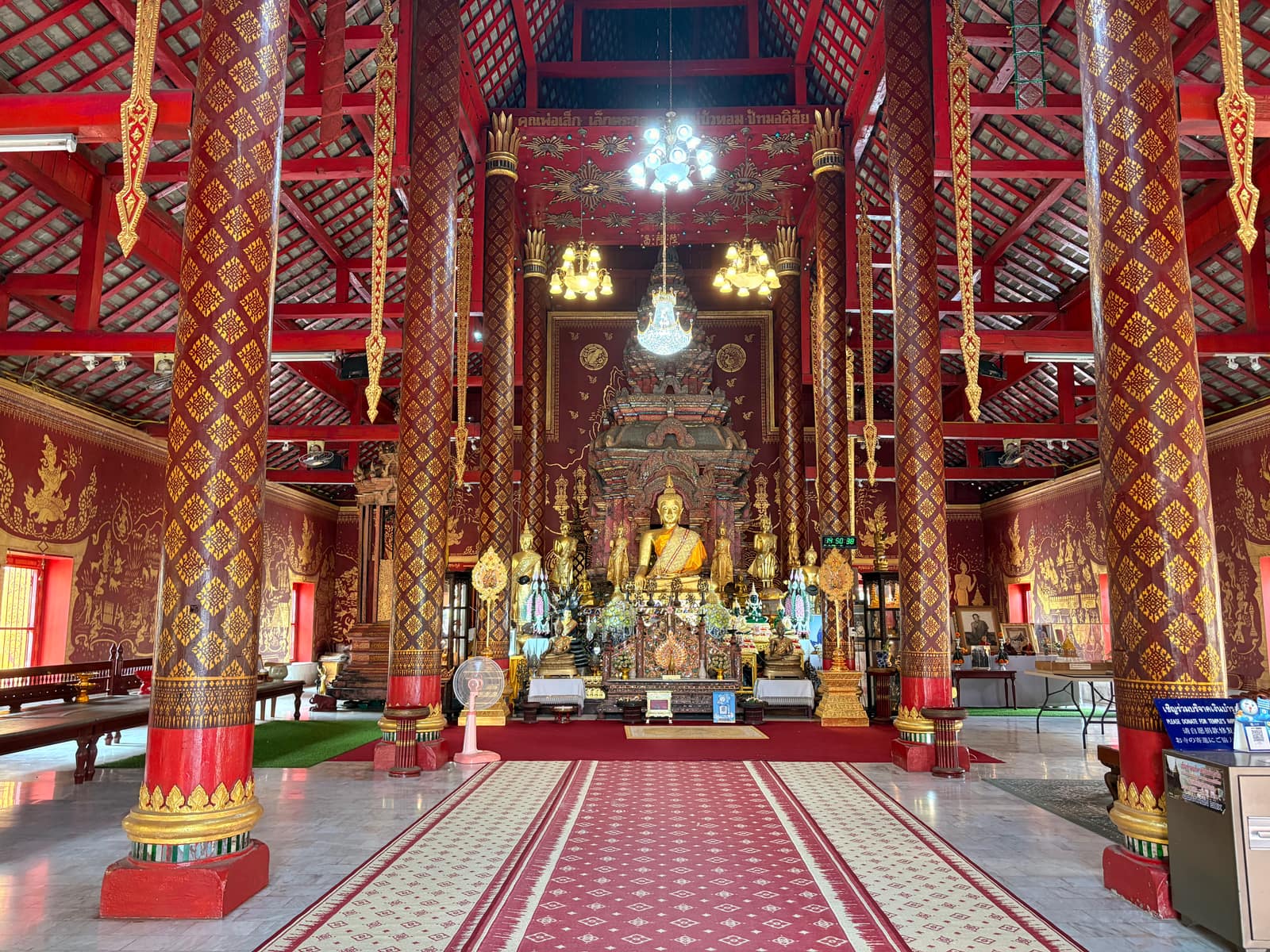
- Inside, teak columns and a red-and-gold ceiling carry the principal Buddha image; the ordination boundary stones (sema) sit outside the hall.
- The ho trai (scripture library) stands on high pillars to keep palm-leaf manuscripts dry and out of reach of termites.
- The compound also holds a smaller wihan, the monks quarters and the temple school — it is a living monastery, not a museum.
Restoration and what changed
Eight centuries of repair mean no single building here is "original". What survives is the plan, the chedi core and the two Buddha images.
- Burmese rule between 1558 and 1775 left the strongest mark on the chedi and the roof lines.
- Major restoration in the 19th and 20th centuries stabilised the stucco elephants and re-gilded the spire.
- The crystal and stone Buddhas have stayed in the temple through every rebuilding — the continuity visitors come for.
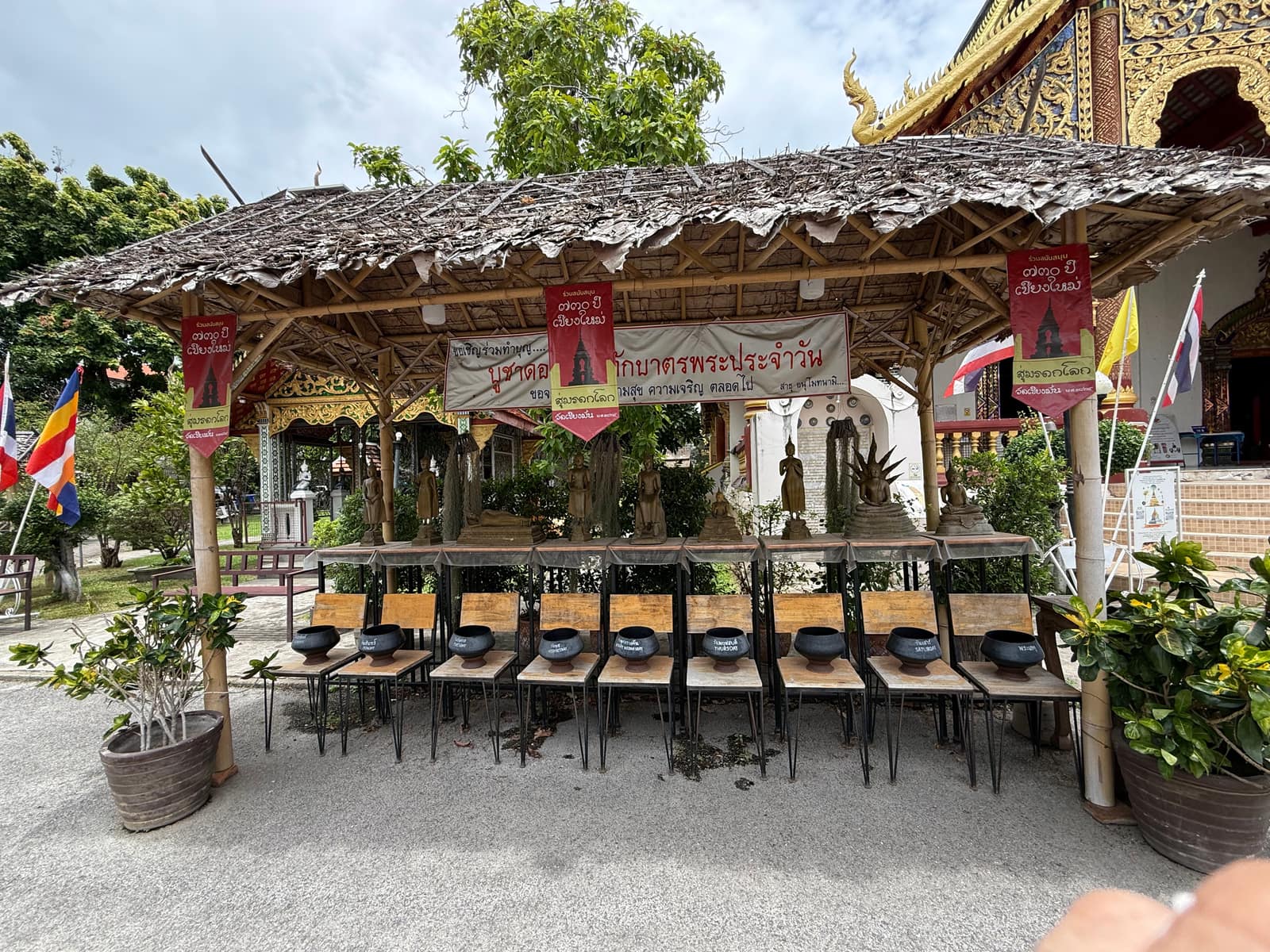
- Ongoing conservation is funded by donations, which is why the offering boxes matter as much as they do.
Frequently asked questions
Why is Wat Chiang Man the oldest temple in Chiang Mai? +
It was founded in 1296 by King Mangrai while he was laying out the new capital of Lanna, before any other temple inside the moat. Continuous use ever since makes it the oldest working temple in the city.
How many elephants support the chedi? +
Fifteen life-size elephant sculptures ring the base of Chedi Chang Lom. Only their fronts are modelled; the bodies form the load-bearing structure of the stupa.
What is the difference between Phra Sila and Phra Kaeo Khao? +
Phra Sila is a small grey-green marble relief Buddha associated with rain-bringing rituals; Phra Kaeo Khao is a small crystal (quartz) Buddha associated with protection. Both are kept in the hall beside the ordination hall.
When can I see the crystal Buddha? +
Both images are carried out publicly during Songkran in mid-April. At other times they remain in the hall and a monk or caretaker will usually open the case if you ask politely.
Keep reading
Wat Chiang Man visitor guide: dress code, etiquette and worship
→ Read the guideHow to get to Wat Chiang Man
→ Read the guideWhat to see near Wat Chiang Man
→ Read the guideWat Chiang Man entrance fee, opening hours and practical details
→ Read the guideWat Chiang Man architecture: what to look for and why it matters
→ Read the guideHalf-day walking route from Wat Chiang Man through Chiang Mai Old City
→ Read the guideThree Kings Monument: Chiang Mai’s founding story and civic square
→ Read the guideWat Chedi Luang: the monumental brick stupa of Chiang Mai
→ Read the guideWat Phra Singh: ornate Lanna halls and a gilded chedi
→ Read the guideWat Lam Chang: an elephant-linked temple in northern Chiang Mai Old City
→ Read the guideChiang Mai City Arts & Cultural Centre: history inside the former civic building
→ Read the guideWat Inthakhin Sadue Mueang: the temple of the city’s navel
→ Read the guide